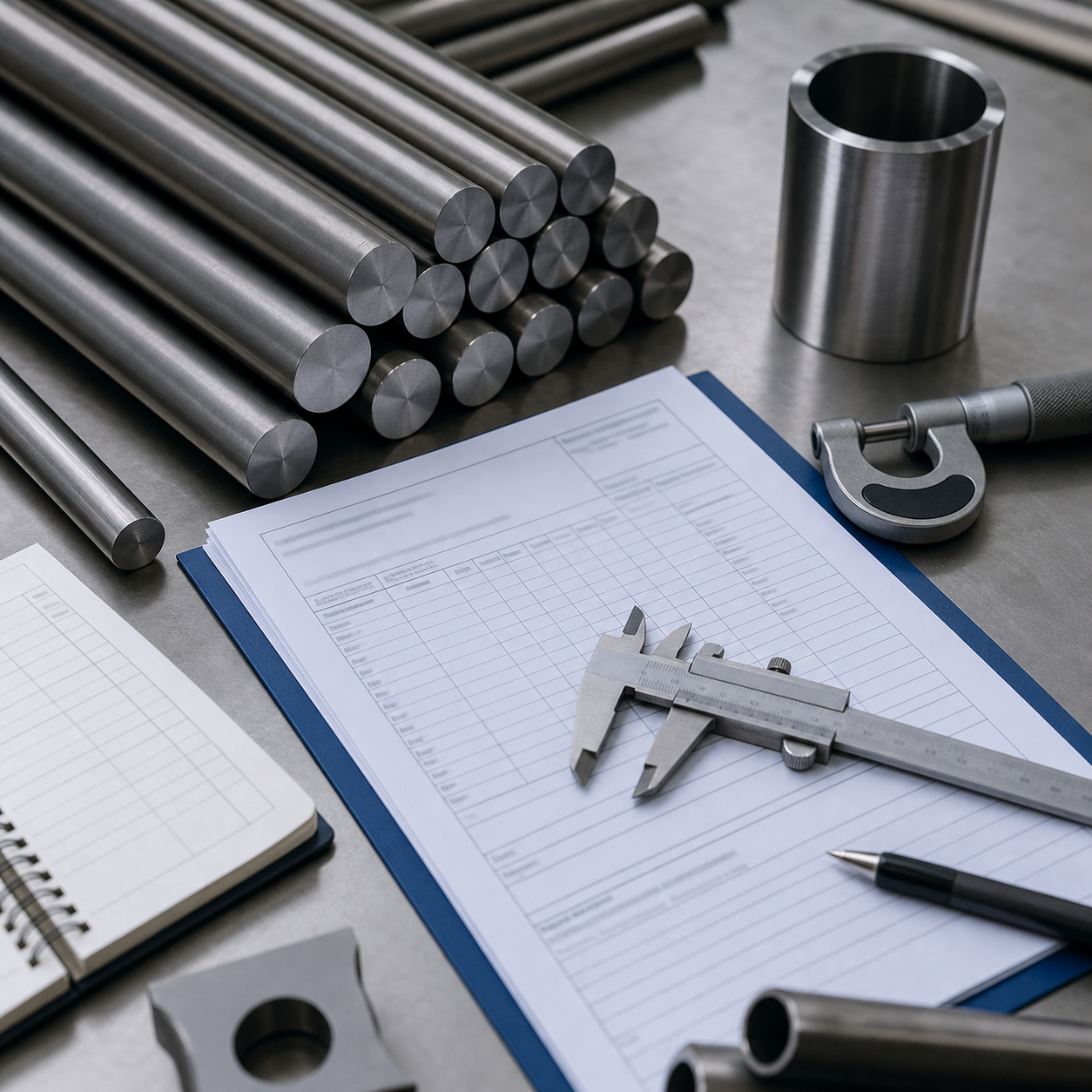
1. Introduction — Why Understanding an MTC Truly Matters
When engineers or buyers receive titanium products—bars, plates, tubes, or forgings—the first thing they often ask for is the Mill Test Certificate (MTC). It is a familiar document, yet many people only glance at it long enough to confirm the grade or chemical composition. Few actually understand how much information an MTC can reveal, or how deeply it influences safety, performance, and compliance.
An MTC is more than a sheet of numbers. It is a record of the material’s journey—where it came from, how it was processed, and whether it truly meets the requirements your project demands. Learning to read it properly gives buyers confidence, reduces risks, and improves communication between engineers, manufacturers, and suppliers.
Before diving into the details, let’s take a moment to understand why an MTC exists and what role it plays.
2. What Exactly Is a Titanium MTC?
A Mill Test Certificate is essentially the manufacturer’s declaration that the titanium material you received complies with relevant standards and specifications. Importantly, it is issued by the producer, not a middleman. The values and signatures on it reflect actual test results from the production batch.
Think of the MTC as a material’s identity card. It verifies that the titanium bar you received is genuinely TC4/Grade 5, that the tubing is truly TA2, and that the chemical and mechanical properties fall within ASTM or AMS limits. Without this document, buyers would have no reliable way to confirm the authenticity or quality of titanium products.
Some buyers confuse MTCs with simple test reports. But an MTC is far more authoritative: it connects every test result back to a specific heat/batch number, allowing full traceability.
3. What a Typical Titanium MTC Looks Like
Most MTCs share a similar structure, even though formats may vary between factories. You will usually find:
- basic material identification
- heat number or batch number
- product dimensions and form
- applicable standards (ASTM, AMS, ISO, GB/T)
- chemical composition
- mechanical properties
- heat treatment condition
- additional tests such as UT or RT
- signatures, stamps, and dates
Each section exists for a reason. Together, they form a complete quality picture that helps buyers verify whether the material is suitable for the intended application.
4. Understanding Chemical Composition — The Foundation of Material Identity
When buyers first open an MTC, their eyes often go straight to the chemistry table. Titanium alloys may look identical on the surface, but their internal chemistry determines their strength, corrosion resistance, weldability, and even color during machining.
An MTC lists elements such as Al, V, O, N, H, Fe, and of course the titanium balance. For pure grades like TA1/TA2 or Grade 1/2, the oxygen content is particularly important. Higher oxygen increases strength but reduces ductility. For TC4 (Ti-6Al-4V), buyers focus on whether aluminum and vanadium content fall within ASTM B348 limits.
A helpful approach is to compare each listed percentage against the acceptable ranges in the standard. If an element sits extremely close to the upper or lower limit, buyers should take note—not necessarily a red flag, but something worth confirming.
Understanding chemistry gives you a sense of what the material should be capable of before you even look at the mechanical properties.
5. Reading Mechanical Properties — Connecting Data to Real-World Performance
Mechanical properties translate chemistry into actual behavior under stress, bending, or load. These numbers tell you how the material will perform in your application.
A typical MTC lists:
- Tensile strength (Rm)
- Yield strength (Rp0.2)
- Elongation
- Reduction of area
- Hardness (HB/HRC/HV)
These numbers are not abstract—they predict whether a titanium sheet can be cold-formed, whether a bar can be safely used in a pressure system, or whether a component will withstand fatigue.
For example, annealed TA2 usually has excellent elongation, making it suitable for bending or welding. TC4, on the other hand, has much higher tensile strength thanks to its α+β structure, making it ideal for aerospace or high-load components.
A good habit is to compare the listed mechanical values with the required minimums in the standard. Significant deviations, especially on the low end, may warrant further investigation.
6. Heat Treatment Condition — A Small Line With Big Consequences
Some buyers overlook the “Condition” field on an MTC, but this small line can change everything. Titanium can be supplied in various conditions:
- Annealed (A)
- Mill Annealed (M)
- Solution Treated (ST)
- Solution Treated and Aged (STA)
Each condition corresponds to a different microstructure, which affects strength, ductility, and suitability for machining or welding.
For instance, TC4 in STA condition is significantly stronger than in annealed condition, but also harder to machine. Understanding the heat treatment listed on the MTC helps avoid mismatched expectations between designers, buyers, and machining shops.
7. Additional Tests — When the Application Demands More Assurance
Depending on the industry, titanium products may undergo additional tests. These appear on the MTC when required by the order or standard.
Common examples include:
- Ultrasonic Testing (UT) for internal flaws
- Radiographic Testing (RT) for weld evaluation
- Dye Penetrant Testing (PT) for surface cracks
- Grain size measurements
- Microstructure evaluation
- Pressure or leak tests for tubing
Not every project needs these, but when they do, these lines on the MTC provide essential assurance that the titanium is free from defects that could compromise safety.
8. Traceability — Following the Heat Number Back to the Source
Perhaps the most underrated part of an MTC is the heat or batch number. This number ties the titanium back to the exact melt from which it originated. In other words, it connects your product to:
- its original ingot
- the furnace and melting process
- the forging or rolling steps
- all tests performed on the batch
If a supplier provides an MTC with no heat number or a number that doesn’t match the physical product markings, this is an immediate red flag. Proper traceability is the backbone of quality control, especially for aerospace, chemical, and medical industries.
9. How to Spot Red Flags — A Practical Checklist for Buyers
Not all MTCs are created equal, and buyers should learn to recognize warning signs. Some common issues include:
- missing heat number
- chemistry values outside of specification
- mechanical properties inconsistent with the stated condition
- no manufacturer stamp or signature
- handwritten corrections without authorization
- MTC issued by a trader instead of the factory
None of these automatically prove a problem, but they should prompt further verification. A reliable manufacturer will always provide clarification and supporting documentation.
10. Comparing an MTC Against Your Requirements
Once you understand the sections of an MTC, the next step is ensuring that everything aligns with your order. This includes:
- Correct grade and standard
- Dimensions and tolerances
- Mechanical properties
- Chemistry limits
- Heat treatment
- Special requirements like UT level or surface finish
This comparison helps avoid misunderstandings and costly rework. It also ensures that the material you purchased is truly suitable for your project’s operating environment.
11. Why Working With a Transparent Manufacturer Makes Everything Easier
A well-structured, accurate MTC reflects the maturity of a manufacturer’s quality system. It shows that they conduct real internal inspections, that their furnace and process controls are stable, and that they assign traceable heat numbers to every batch.
For buyers, this transparency means fewer disputes, fewer delays, and greater confidence—especially when dealing with critical titanium components.
12. Conclusion — Turning the MTC Into a Powerful Decision-Making Tool
Reading an MTC is not merely about checking a box; it is about understanding the material beneath the surface. Once you learn to interpret its chemistry, mechanical properties, heat treatment, and traceability, the MTC becomes a powerful tool—one that helps buyers make informed choices and engineers design safely and confidently.
And if you ever encounter an MTC you’re unsure about—or need guidance on verifying titanium grade, reviewing test results, or comparing certificates—our team is always here to help. Good decisions start with good information, and a clear MTC is where that journey begins.
Share this article

Written by : Young Things Metal Co,LTD
Follow us
Table Of Content
- 1. Introduction — Why Understanding an MTC Truly Matters
- 2. What Exactly Is a Titanium MTC?
- 3. What a Typical Titanium MTC Looks Like
- 4. Understanding Chemical Composition — The Foundation of Material Identity
- 5. Reading Mechanical Properties — Connecting Data to Real-World Performance
- 6. Heat Treatment Condition — A Small Line With Big Consequences
- 7. Additional Tests — When the Application Demands More Assurance
- 8. Traceability — Following the Heat Number Back to the Source
- 9. How to Spot Red Flags — A Practical Checklist for Buyers
- 10. Comparing an MTC Against Your Requirements
- 11. Why Working With a Transparent Manufacturer Makes Everything Easier
- 12. Conclusion — Turning the MTC Into a Powerful Decision-Making Tool
Latest articles
October 15, 2026

October 15, 2026